
This article is provided for general information only and does not constitute legal or financial advice. Funding terms are agreed on a case-by-case basis.
Introduction
When a funded claim succeeds, the money goes through a pre-agreed sequence of payments before reaching the claimant. This is referred to as the ‘distribution waterfall’. The waterfall sets out who is paid, in what order, and from which pool of money. The funding waterfall is one of the most important terms that a claimant will need to negotiate before a funder commits capital.
This article breaks down a simple, illustrative waterfall from start to finish. The figures used are invented, and the structure is kept deliberately straightforward, but the mechanics are the same ones that govern real funding scenarios.
Litigation Funding Waterfall: Five Key Terms Explained
While most of the vocabulary used in this article is explained as it arises, here are five terms worth defining first:
- Litigation funding waterfall: The agreed order in which the proceeds of a successful claim are paid out to the interested parties. Each payout stage must be paid in full before money flows to the next stage.
- Invested capital: The total amount the funder has paid out to support the claim. This differs from committed capital (the maximum funds the funder has agreed to make available regardless of whether it is fully utilised). Repayment of invested capital is almost always the first level of the waterfall.
- Funder's return: What a funder receives on success, on top of getting its invested capital back. It is the funder's reward for bearing the risk of losing everything if the claim fails. It is usually the higher of two figures: a multiple of the invested capital, or a percentage of net proceeds.
- After-the-event (ATE) insurance: Insurance taken out after the dispute has started. It covers the claimant against adverse costs (the opposing party's legal costs). In some jurisdictions, a losing claimant may be ordered to pay these legal costs. ATE premiums appear at two different levels of a typical waterfall.
- Pari passu: Latin for "on an equal footing". Parties ranking pari passu are paid at the same level of the waterfall with equal priority. If the available proceeds are insufficient, each receives a pro rata share rather than one being paid in full ahead of the other.
The starting assumptions
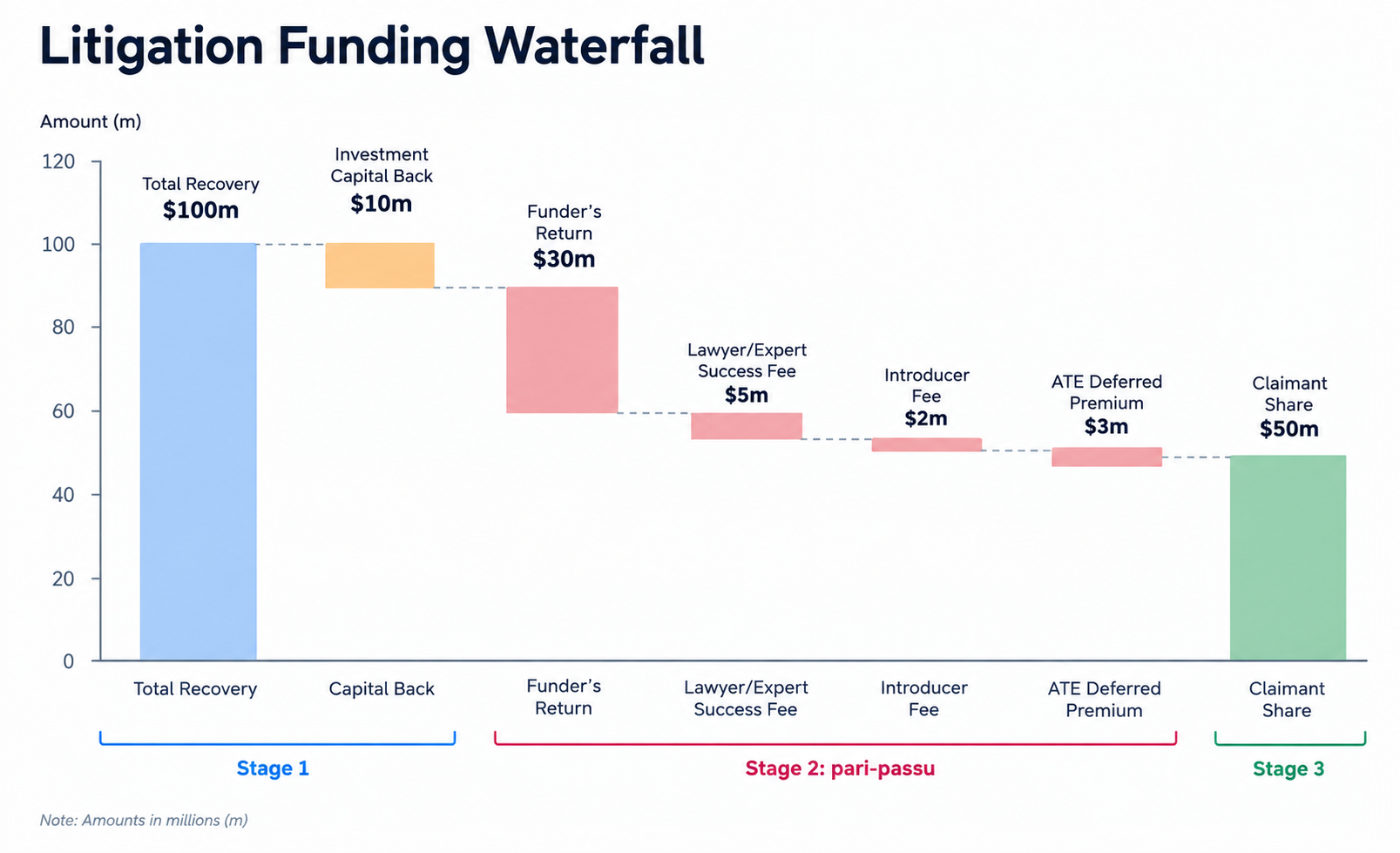
For illustrative purposes, let's assume a claimant achieves a successful recovery of $100 million. The recovery could arrive via judgment, award or settlement. A litigation funder has backed the claim with $10 million of capital. That $10 million covers the legal budget: legal fees, court and tribunal fees, expert fees, upfront ATE premiums and other litigation-related disbursements. Under the litigation funding agreement (LFA), this capital is repaid from the proceeds first.
On success, the funder is entitled to a $30 million return. The lawyers and experts receive a success fee equal to 5% of the recovery ($5 million). This is an uplift for having accepted reduced or deferred fees during the case. This is typically agreed under a conditional fee agreement, a damages-based agreement or a bespoke arrangement.
An introducer fee of 2% of the recovery proceeds ($2 million) is payable to the party who brought the claim to the funder or the legal team. A deferred ATE premium of $3 million is also payable, and like the other fees, is due if the claim succeeds.
Once the funder's capital has been repaid, the remaining proceeds are used to pay the funder’s return on investment, the legal and expert success fees, the introducer fee and the deferred ATE premium. These are paid pari passu. No further deductions, taxes or enforcement costs are assumed.
A note on ATE insurance
After-the-event (ATE) insurance protects claimants against adverse costs. In many funded cases, the funder pays the premium as part of the legal budget. That is why it appears within the funder's invested capital above.
ATE premiums are commonly structured in two parts. The upfront premium is paid when the policy is taken out. Because ATE is funded from the legal budget, it forms part of the invested capital repaid at Stage 1. The deferred premium is only paid if the claim succeeds, and it comes out of the proceeds at Stage 2, alongside other success-based payments. The price of both elements depends on the risks of the case and on negotiation with the insurer.
ATE premiums are not always structured as an upfront payment plus a deferred premium. Depending on the insurer, the case risk, and the outcome of negotiations, the premium may be payable as a single payment or under alternative arrangements, such as instalment plans.
How the funder's return is calculated
Funders do not typically take a flat fee. Instead, their return is usually expressed as the higher of two figures:
- A multiple on invested capital: a fixed multiple of the money the funder has put in. For example, a 3x multiple on $10 million produces a $30 million return.
- A success fee: a percentage of net proceeds. This is typically defined as the total recovery minus the funder's invested capital. Definitions of net proceeds vary between agreements and should always be checked.
Both the multiple and the percentage typically rise at defined points in time. This reflects a simple fact: the longer the funder's money is at risk, the more it costs the funder to deploy.
In this example, assume the case has reached a stage where a 3x multiple and a 30% success fee apply:
- Multiple: 3 × $10 million = $30 million
- Success fee: ($100 million − $10 million) × 30% = $27 million
The multiple produces the higher figure, so the funder's return is $30 million. Had the recovery been larger, the percentage-based figure would eventually overtake the multiple. The "higher of" structure is designed to reward the funder proportionately in a large win while protecting it in a modest one.
Stage 1: repayment of invested capital
The first call on the recovery is the return of the funder's capital. This is a repayment, not a return. The funder simply receives the money it put at risk. No party has earned anything yet.
.png?width=1448&height=1086&name=ChatGPT%20Image%20Sep%2017%2c%202026%2c%2004_14_29%20PM%20(1).png)
Stage 2: pari passu distribution of contingent payments
From the $90 million that remains, four parties are paid at the same time and with equal ranking. Here, the $90 million is more than enough to pay every Stage 2 party in full. So the pari passu ranking makes no practical difference. Pari passu matters when the recovery is smaller than expected. If there is not enough at Stage 2 to recompense all four parties, no party ranks above the other in repayment. Each party then receives a pro rata share of what is available. That is the protection that pari passu offers. It is also why parties engaged in funding pay close attention to who sits at which level of disbursements.
.png?width=1448&height=1086&name=ChatGPT%20Image%20Sep%2017%2c%202026%2c%2004_14_29%20PM%20(2).png)
Stage 3: the claimant's share
Whatever remains after Stages 1 and 2 goes to the claimant. This is the claimant’s share: the balance of the recovery once every level of the waterfall above it has been paid. In this example, the claimant keeps half of the gross recovery. They would have paid none of the legal costs during the life of the case and none of the adverse costs risk had the claim failed.
.png?width=878&height=659&name=ChatGPT%20Image%20Sep%2017%2c%202026%2c%2004_14_29%20PM%20(3).png)
The full waterfall at a glance
.png?width=1448&height=1086&name=ChatGPT%20Image%20Sep%2017%2c%202026%2c%2004_14_30%20PM%20(4).png)
Summary: Why real waterfalls differ
The structure above is one possible arrangement, chosen for clarity rather than realism. In practice, almost every element is negotiated and tailored to the case:
- Funding terms vary with the size of the budget, the expected duration, the jurisdiction and the strength of the claim. Multiples and percentages differ from funder to funder and from case to case.
- Success fees for lawyers and experts depend on the fee arrangement in place. This may be a conditional fee agreement, a damages-based agreement or a hybrid of the two.
- ATE insurance may not be required at all in some jurisdictions. Where it is, the split between upfront and deferred premium is negotiated with the insurer.
- Waterfall distributions may rank parties at different levels rather than pari passu. They may include caps or floors on the claimant's share, and may deal with enforcement costs, taxes and partial recoveries in a range of ways.
The value of working through a simplified example is that it makes the underlying logic visible: capital is returned first, contingent payments are made from what remains, and the claimant receives the balance. Once that logic is clear, negotiating any waterfall becomes a question of where each party sits in it and on what terms.
Litigation Funding from a European Perspective
Litigation funding opportunities are rising in Europe as the market matures and responds to a shifting landscape shaped by new regulations, COVID upheaval and societal change.
In this whitepaper we take a closer look at what’s driving change in the region and the issues claimants and funders should consider if they are to successfully navigate their way through it.
Download the whitepaper now