
This article is for general information only and is not legal or financial advice. Funding terms are agreed case by case. Rules on CFAs, DBAs and contingency fees vary by jurisdiction.
Introduction
Many businesses assume that pursuing a legal claim means paying for it themselves. Legal fees come out of operating cash. The budget competes with hiring, product and growth. Boards often decide the money is better spent elsewhere, and a valid claim is written off as non-recoupable.
That assumption is out of date. A business with a strong case may have several ways to pursue it without draining its own balance sheet, with litigation funding being one of these methods.
Other options include conditional fee agreements, damages-based agreements, contingency fees, bank loans and after-the-event insurance. Each shifts a different slice of risk onto a different party. Each method distributes financing in various ways. The right choice – which might involve a combination of these structures - could allow a company to recover what it is owed while keeping its capital free for the business.
This article sets out how litigation funding differs from the alternatives. For each option, it answers four questions. Who provides the money? Who loses out if the case fails? Does the claimant have to pay whether it wins or loses, or only if it wins? And what does it cost? Finally, we look at how these options are often combined into a single funding package.
Litigation Funding vs Other Options: Five Key Terms Explained
Most of the vocabulary in this article is explained as it arises; however, here are five terms worth defining first:
- Non-recourse funding: Money is only repaid if the case succeeds. If the claim fails, the funder loses its investment capital, and the claimant owes nothing. Litigation funding, damages-based agreements (“DBAs”) and conditional or contingent fee arrangements are all examples of non-recourse funding.
- Recourse financing: Money that must be repaid whatever the outcome. A bank loan is the typical example. If the claim fails, the borrower still owes the full amount plus interest. If the borrower cannot pay, the lender can enforce against the borrower's other assets, and against any assets pledged as security for the loan, such as property, receivables or shares in the business.
- Multiple on invested capital (MOIC): One of two ways a funder's return may be priced. The funder receives a set multiple of the capital it has actually deployed, on top of getting that capital back. As an example, a funder that has deployed $10 million at a 3x MOIC receives a $30 million return plus its $10 million back, so $40 million in total. Multiples typically step up the longer the case runs. Depending on the jurisdiction, many funding agreements provide for a return based on the higher of the MOIC and a percentage of net proceeds, which might also increase with duration.
- Success fee: An extra amount payable to, for example, a law firm only if the case succeeds. Under a conditional fee agreement (“CFA”), it is usually set as a percentage uplift on the lawyer’s base fees, not on the damages. For example, a 50% success fee on £1 million of base fees would be £500,000, so the firm would receive £1.5 million in total on a win and only its deferred or reduced base fees, or nothing, on a loss. In England and Wales, the uplift is capped at 100% of base fees (with a further cap applicable in personal injury cases). The term can also refer to a funder's return, so check which meaning a document intends.
- Adverse costs: The opponent’s legal costs in relation to the dispute. Depending on the jurisdiction and the circumstances, the court may order the losing side to pay the winning side’s costs. This "loser pays" principle generally applies in England and Wales, Hong Kong, Singapore and most other common law jurisdictions (a notable exception being the United States), and in modified forms across much of Europe. However, the order rarely covers the winner's full costs. In England and Wales, for example, the court has a wide discretion to determine the amount of costs payable and by whom and will consider factors such as the extent of success and the conduct of the parties when making its decision. A claimant may be able to purchase “After-the event” or “ATE” insurance against the risk of being ordered to pay adverse costs.
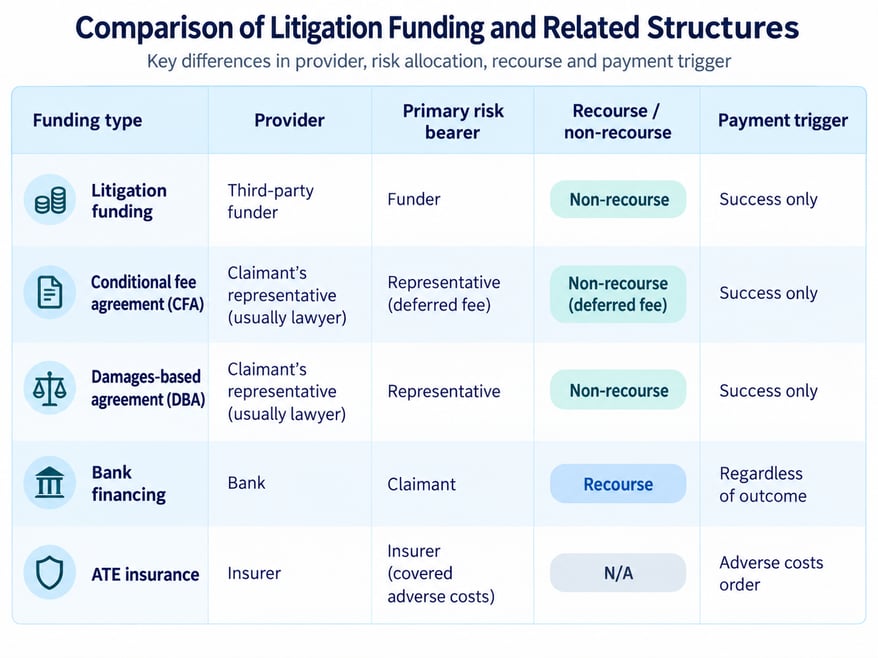
Litigation Funding vs CFAs, DBAs, Bank Loans and ATE Insurance: Comparison Table
The table below sets out a broad-brush comparison between these various financing structures and how they generally operate, though of course each such arrangement will be individually negotiated and specific terms may vary.
What Is Litigation Funding and How Does It Work?
A third-party funder may pay some or all of the costs of running a claim. For a fuller introduction, see our guide to what litigation funding is and how it works. In short, it can cover the full legal budget: solicitors' and barristers' fees, court or tribunal fees, expert fees and other related expenses. It might also cover the upfront premium on an ATE insurance policy.
The precise terms and structure of a third-party funding arrangement will be set out in the litigation funding agreement. In general:
- The claimant will retain control of its case; the funder will usually require that it is kept informed and is involved in key decision-making but will not direct the claim.
- The funder's capital is only repaid if the claim succeeds. If the claim fails, the funder loses its investment, and the claimant owes nothing.
- If the claim succeeds, the funder is paid from the proceeds. It first recovers its capital, then receives a return on top.
- Depending on the jurisdiction, that return is usually calculated in two ways, and the funder takes whichever is higher: a multiple of the capital it invested, or a percentage of the net proceeds. Both the multiple and the percentage tend to increase the longer the case runs.
- How these payments are sequenced is covered in our article on the litigation funding waterfall.
Litigation funding stands apart from the other options in two ways. First, and if agreed with the funder, the funds may cover the whole legal budget, including court fees, expert fees and insurance premiums, not just the lawyers' fees. Second, the risk of losing sits with a specialist third party rather than with the claimant or the law firm. The law firm is paid at least some portion of its fees as the case proceeds, and the claimant has none of its own money at stake.
If ATE insurance is used as part of the funding, its structure will normally consist of an upfront premium and a deferred premium. As noted above, the third-party funder may cover the upfront premium. The deferred premium is often payable upon success and deducted from the proceeds pari passu with the funders’ return. Accordingly, the ATE insurer also assumes the risk of receiving no deferred premium and covering the adverse party costs in the event of a loss.
Conditional Fee Agreement (CFA): No Win, No Fee Explained
A CFA is an agreement between the claimant and its legal representative whereby the representative agrees to defer some or all of its fees until the end of the case. Where all fees are deferred (a standard CFA), the claimant pays nothing for the lawyer’s time if the claim fails, and if the claim succeeds, the claimant pays the base fee plus a success fee. Where only part of the fees is deferred (a discounted CFA), the claimant pays a reduced proportion of base fees during the case, for example 70%, and the balance is payable only on success. If the claim fails, the deferred fees are not paid. If it succeeds, the lawyer recovers the deferred fees plus a success fee.
The success fee is calculated as an uplift on the base fee, not on the damages recovered. In England and Wales, it is capped in most cases at 100% of the base fee. The success fee cannot be recovered from the losing side and comes out of the claimant’s damages.
The risk under a CFA sits largely with the lawyer, though less so under a discounted CFA, where the claimant has already paid part of the fees. A CFA usually covers the lawyer’s own fees only, not court fees, expert fees or adverse costs, so it is often paired with litigation funding or ATE insurance.
Damages-Based Agreement (DBA): Lawyers Paid from Damages
A DBA is also an agreement with a representative (usually but not only the claimant’s lawyer), but provides for the representative to be paid a share of the damages in the event of success, rather than an uplift on its fees. If the claim fails, the representative receives nothing.
In England and Wales, the representative’s share is capped at 50% of the sums recovered in most commercial claims. As with a CFA, a DBA usually covers only the representative's fees, and the representative bears the risk.
DBAs are far less prevalent than CFAs and are barred in certain categories of claim, for example in opt-out collective actions before the England and Wales Competition Appeal Tribunal.
Bank Loans for Litigation: The Recourse Option
A claimant may also borrow the money to fund their case from a ‘traditional’ recourse lender. A bank loan is a form of recourse finance. This type of loan must be repaid with interest regardless of whether the claim is won or lost and might also be secured against the claimant’s assets.
Here, the claimant retains all the risk and payment is due regardless of outcome. In practice, banks are reluctant to lend against litigation. Loans of this nature are not structured to assess legal merits, as a claim is not an asset that they can easily value or seize. Where a loan is available, it tends to be priced on the borrower’s balance sheet, not on the strength of the case.
After-the-Event (ATE) Insurance: Covering Adverse Costs
After-the-event insurance is not a funding source. It generally does not cover the claimant’s own legal fees, although some policies may cover certain disbursements. Instead, its primary purpose is to protect the claimant against adverse costs if the claim is unsuccessful.
The claimant pays a premium, usually split between an upfront element and a deferred element that is only paid on success. If the case fails and an adverse cost order is made, the insurer pays the other side’s ordered costs up to the policy limit.
ATE insurance sits alongside the other options rather than competing with them. It deals with a risk that none of the others covers.
In Summary: Putting the right package together
These options are not mutually exclusive. They are often used together. A common structure pairs litigation funding with a CFA or DBA and ATE insurance. The funder covers the legal budget. The law firm takes part of its fee at risk under the CFA. The insurer covers adverse costs. The result is a package in which the claimant's financial exposure is close to nil for the life of the case.
The trade-off is cost. Each party taking on risk is paid for doing so on success, and those payments all come out of the recovery before the claimant is paid. How that plays out is the subject of the waterfall article.
Litigation Funding from a European Perspective
Litigation funding opportunities are rising in Europe as the market matures and responds to a shifting landscape shaped by new regulations, COVID upheaval and societal change.
In this whitepaper we take a closer look at what’s driving change in the region and the issues claimants and funders should consider if they are to successfully navigate their way through it.
Download the whitepaper now